The Last Credit: How Off-Season Arcades Became Britain’s Warmest Night Out
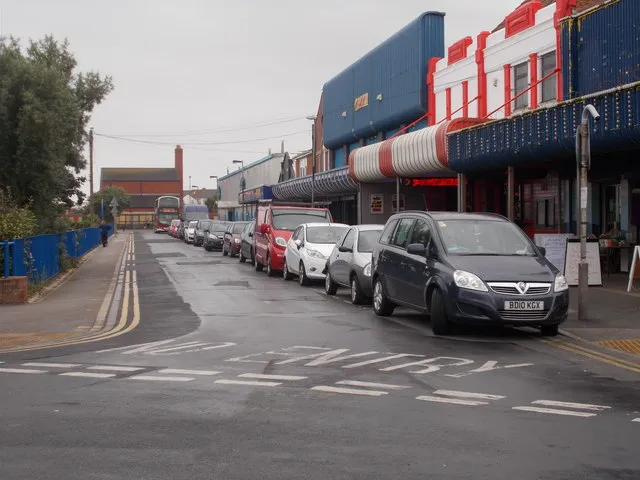
Photo: Betty Longbottom, CC BY-SA 2.0, via Wikimedia Commons
The promenade at 11pm in November is not where you expect to find a queue. The tide is somewhere out in the dark, the fish and chip shops have pulled their shutters down, and the last train has already been missed by several people who do not seem remotely bothered. They are heading inland, slightly, towards a doorway leaking blue light and the unmistakable sound of a change machine clearing its throat.
This is the British seaside arcade after hours. Not the daytime version with sticky carpets and a soundtrack of distant fruit-machine bleeps, but the version that has quietly started happening in off-season coastal towns: DJs setting up between the cabinets, chiptune acts plugging Game Boys into the PA, and retro gaming tournaments that run until the cleaners arrive. In 2026, the arcade is not just a place to lose 2p pieces. It is becoming a warm, dry, faintly ridiculous alternative to the club.
The promenade after the last train
Off-season Britain is a specific mood. The illuminations are switched off, the deckchair stacks are wrapped in plastic, and the wind has a bite that makes a smoking area feel like a punishment. For years, the night-time economy in places like Blackpool, Margate, Scarborough and Great Yarmouth has had to work around that. Clubs close, pubs trim their hours, and the seafront becomes a place for dog walkers and people waiting for the first bus.
Arcades have an advantage that few venues can match: they are already there, they are already lit, and they are already full of noise. A premises licence can be varied to allow recorded music and late-night refreshment. A back room can become a tournament space. The machines do not need a headline slot. The whole floor is the show.
'We were losing the winter,' says one owner in Margate, leaning against a cabinet that has clearly seen several decades of coastal weather and several thousand packets of crisps. 'Now we do a Friday thing, a DJ and a few tables, and people come out who would never go to a club. They play OutRun, they have a beer, they leave at one. It is not complicated.'
That simplicity is the point. Arcades offer a night out without the rituals of a club: no dress code, no queue politics, no pressure to stay on a dancefloor you are not enjoying. You can stand at a cabinet, watch someone else's screen, drift between groups. For anyone who finds clubs overwhelming, or expensive, or simply too loud to talk in, the arcade floor is a different social contract.
Chiptune on the carpet
The musical end of this is more serious than it might sound. Britain has a long-running chiptune scene, with artists using Game Boys, trackers and handheld consoles to make music that is part pop, part punk, part physics experiment. Those acts have traditionally played in small venues and at festivals. Arcades give them a natural home: the audience is already looking at screens, the room already sounds like a console, and nobody needs to explain why a song might feature a sample of a coin dropping.
In Brighton and Scarborough, promoters have started pairing chiptune sets with retro tournaments. The DJ plays between matches. The matches are projected onto a wall. The bar sells cans. It is a world away from the polished function-room club night, and that is precisely why people turn up.
'You can do a set at midnight and the room does not have to be dark,' says one organiser. 'The lights are on. The cabinets are glowing. People are sitting on the floor. It feels like a living room that happens to have a Street Fighter cabinet in it.'
Licensing the beeps
None of this happens without the unglamorous work. Council licensing teams need to be satisfied that late-night music will not become a nuisance. Door staff, CCTV, noise limits and last-entry times all apply. The advantage for arcades is that the sound is contained: a DJ in a room full of cabinets is not the same as a stack of subs in a marquee. The disadvantage is that old buildings have thin walls, neighbours have long memories, and a 1am chiptune set can carry further than you think.
The best operators have learned to work with that. They programme the loudest sets earlier, keep the doors closed, and use the arcade's natural layout to break up sound. They talk to the council before the first event, not after the first complaint. It is not rock and roll, but it is what keeps the machines running.
Machines, money and the morning after
There is also the small matter of keeping the cabinets alive. Old PCBs fail. CRT monitors develop faults that no one under 30 has been trained to fix. Parts are scarce, and the people who know how to repair them are often the same people running the night. At the good arcades, the owner is part technician, part host, part bouncer. They know which machine is temperamental, which tournament needs a spare controller, and which regular will help move a table without being asked.
The economics are thin but strangely resilient. Entry fees, tournament sign-ups, a simple bar and the usual daytime trade all add up. The overheads are lower than a club's because the room is already there. The risk is that it becomes a victim of its own success: too many people, too much noise, too many complaints. The answer, operators say, is to keep it small and keep it local. 'We are not trying to be a superclub,' one says. 'We are trying to be the best possible room on a wet Tuesday.'
A different kind of door policy
The progressive case for the late-night arcade is not just that it is fun, though it is. It is that it widens who gets to have a night out. Parents with older teenagers can come early. Sober people can stay late. People who do not drink at all can still buy a token and play. The flashing lights and noise are not for everyone, but the arcade has an advantage over the club: you can see the exit, you can sit down, and you can leave without feeling like you have failed at the night.
There are still barriers. Many seaside arcades are not fully step-free. Accessible toilets are not a given. The loudest rooms can be overwhelming for neurodivergent visitors. The best venues are working on it, often with the help of the communities that use them. That work matters as much as the line-up.
What the tide brings in
By 2am, the promenade is empty again, but the arcade is not. A few people are still playing, a few are talking, and someone is trying to explain the rules of a fighting game to a stranger who has clearly never played it before. Outside, the sea is doing its usual thing in the dark.
The British night out has always been a patchwork of strange rooms: working men's clubs, basements, back rooms, bowling alleys. The late-night arcade fits into that tradition. It is not replacing the club, and it should not try to. It is offering something else: a place where the night can be playful rather than intense, warm rather than cool, and open to people who thought the last train home was the end of the evening. The last credit, it turns out, is not the end of anything.