Pavement Discos: How Headphone Parades Are Rewiring the British Night Out
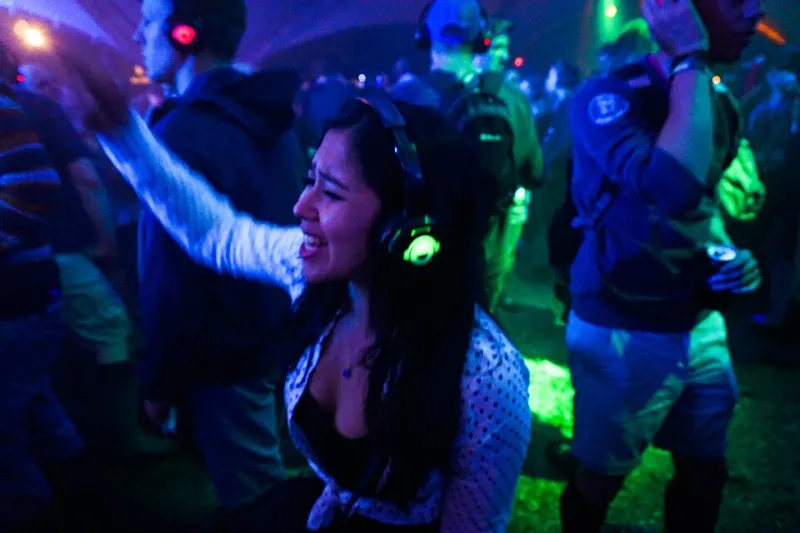
Photo: Czampal, CC BY-SA 4.0, via Wikimedia Commons
At 9.30pm on a wet Thursday in Bristol, a dozen people are dancing outside a coffee shop to a song nobody else can hear. A guide at the front holds a small sign. The dancers wear glowing headphones. A taxi slows down, then speeds up. A cyclist laughs. The group turns a corner, crosses a bridge and keeps moving. For four minutes, the pavement is a club. Then the track changes, the guide waves everyone on, and the city swallows them again.
Silent disco walking tours and headphone parades are no longer a novelty hen-do format. In 2026 they have become a genuine after-dark activity in UK cities, part performance, part protest, part public dance floor. You pay £15–£25, you get a pair of wireless headphones, and you follow a route through streets that were not designed for dancing. The effect is strange and lovely: a private party moving through a public place, with no speakers and no obvious permission slip.
The city as a movable dance floor
The format is simple. Everyone wears headphones with a few channels — usually a cheesy pop channel, a house channel and a guilty-pleasures channel. A guide-DJ leads the group, dropping cues and choreography over the mic. Because there is no amplified music, the group can move through spaces that would never license a sound system: pedestrian bridges, market squares, harbour paths, park edges, the quiet side of a station.
That mobility is the thrill. You see a city you know in a different order. A bus shelter becomes a stage. A underpass becomes a corridor. A row of bins becomes a barrier. The joy is not just dancing; it is dancing somewhere you are not supposed to. It is the mild delinquency of a flash mob without the admin.
Why silent works when noise doesn't
On paper, silent disco parades solve a lot of problems. No noise complaints. No sound limits. No neighbour wars. Councils can grant a route without worrying about bass bleeding into flats. Operators can run later than a venue might allow. And audiences who might not set foot in a club — older people, sober people, people who do not like crowds — can join a group and still feel the rush of a night out.
But silent is not a loophole. Public space still has rules. Operators need permits, risk assessments and insurance. Routes have to be agreed. Headphone volume has to be managed. If a group stops in a residential square at 11pm and starts doing the Macarena, the neighbours will still notice. The difference is that the complaint is about behaviour, not decibels. That matters, but it does not make the format frictionless.
The friction: access, licensing and the right to party
There is a progressive case for headphone parades, and a progressive critique. The case is that they open up nightlife to people who are priced out of clubs, put off by crowds or simply bored of standing in a dark room. They are sociable without being chaotic. They make public space feel playful. They can be run at low cost and with low environmental impact.
The critique is that they can also feel like a private party taking over a public pavement. Not everyone wants to dodge a conga line on their way home. Routes can be inaccessible: cobbles, steps, narrow bridges and busy crossings are not great for wheelchairs, mobility scooters or people with sensory sensitivities. Headphones can be uncomfortable. The cost is still a barrier. And if the format grows without consultation, it risks becoming another way for paying customers to colonise space that belongs to everyone.
The best operators know this. They build step-free routes, offer quiet channels, brief dancers on pavement etiquette and work with councils rather than around them. The worst treat the city as a backdrop. The difference is obvious within five minutes of joining a parade.
Routes worth booking this winter
Bristol. The Harbourside loop from Millennium Square towards Queen Square is a classic for a reason: wide pavements, water views and enough corners to make the route feel like a journey. Look for operators who start after 8pm and finish near a bus stop.
Manchester. A Northern Quarter to Ashton Canal route works well after dark, when the streets are busy enough to absorb a group but not so packed that you become a hazard. The canal stretch gives the parade a proper cinematic moment.
London. The South Bank to Bankside route is the obvious choice, and still one of the best. The Thames does half the work. Book a weekday if you want space; weekends are chaos in the best way.
Glasgow. A Clyde Arc and Pacific Quay loop gives you big skies, reflective water and a satisfying sense of leaving the city behind without actually leaving it. Wrap up warm.
Leeds. The Calls Landing to Leeds Dock route is short, flat and friendly, with enough bars at either end to make a night of it. Good for first-timers.
Cardiff. Cardiff Bay's barrage path is a strong winter route: wide, flat and dramatic when the light goes down. Check the weather before you book — the bay wind is not messing about.
Brighton. The seafront stretch towards Hove Lawns is the obvious pick, but the best operators add a loop through the Lanes first. It turns a walk into a proper parade.
What the format says about 2026 nightlife
Headphone parades are a symptom of something bigger. Nightlife is leaving the venue. It is becoming a route, a walk, a temporary occupation of public space. That is partly about licensing and noise, partly about cost, and partly about a generation of audiences who want to dance without being trapped in a basement until 4am.
The format is not the future of clubbing. It is something else: a hybrid of guided tour, flash mob and outdoor disco that works because it is slightly silly. The joy is real. So is the friction. If UK cities can get the balance right — accessible routes, fair pricing, genuine consultation, better transport — the pavement disco could become a genuinely progressive part of the night-time economy. If they get it wrong, it will be another cute idea that priced out the people it was supposed to include.
For now, the sight of a dozen adults dancing silently past a bus stop is one of the most hopeful things on a British high street after dark. It is not a club. It is not a protest. It is a moving room with no walls, and for a few songs it belongs to everyone.