Top Deck, Last Orders: The Night Bus Choir Rewriting the Journey Home
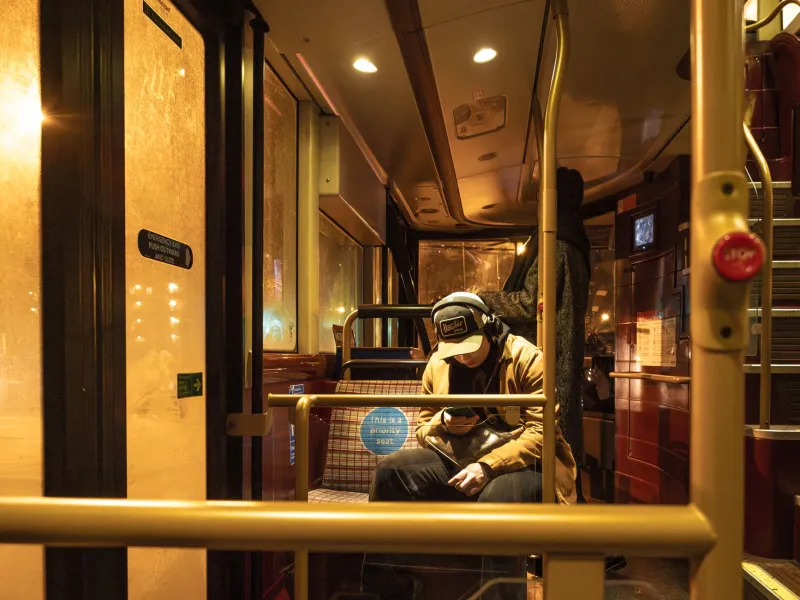
There’s a particular sound that belongs to the top deck of a night bus. It’s not the engine, though that’s there. It’s not the automated announcement telling you the next stop has been renamed after a broadband provider. It’s people singing — badly, quietly, joyfully — because the doors have closed, the club is behind them and for twenty minutes nobody has anywhere else to be.
I’m on a Friday-night route in east London, heading out as the West End empties. At the front, a driver I’ll call Marcus is doing what good drivers do: watching the mirror, watching the road, watching the group of nurses who have decided that the back seat is now a vocal booth. One of them is harmonising with a stranger. Another is using a chip fork as a conductor’s baton. Nobody has asked for permission. Nobody has asked them to stop.
This is not a licensed venue. It is not a ticketed event. It is a bus — and increasingly, in 2026, it is one of the most honest after-hours music rooms in Britain.
The 2AM Choir
The idea of the night bus as a social club is not new. What feels new is how consciously people are treating it. In London, where the night bus network still runs over 100 routes, regulars know which services attract the post-club crowd and which are strictly for night workers. On the top deck, playlists are passed around by phone. Someone will start a song and someone else will finish it. A hen party will adopt a stranger. A group of lads will discover, to their apparent horror, that they know every word to a Sabrina Carpenter chorus.
“It’s the in-between hour,” says Leila, a bar supervisor heading home after a shift in Shoreditch. “You’re not at work, you’re not home, you’re not asleep. The bus is the only place where you can be a bit silly without anyone expecting you to buy a drink.”
That in-between quality is the point. Nightlife doesn’t end when the lights come up; it ends when everyone gets home. The bus is the green room between those two states — a place to decompress, to sing, to cry a little, to eat a bag of crisps with the intensity of a religious ritual.
A Driver’s-Eye View
Marcus has been driving nights for eleven years. He has seen fights, proposals, a man carrying a goldfish in a pint glass, and a woman who insisted on doing a full stand-up routine down the aisle. He is not romantic about the job. But he is clear about what works.
“After 1am, if the bus is half-full and nobody’s kicking off, I’ll put a low-volume playlist on,” he says. “Nothing with swearing. Nothing that’ll wake the person asleep against the window. It changes the atmosphere. People come upstairs expecting trouble. They get Stevie Wonder and a bit of peace.”
It’s not official policy. Transport for London doesn’t issue a “singalong protocol” to drivers, and operators outside London are even less likely to. But the best drivers understand that a night bus is not just a vehicle. It’s a room with a route. The tone is set at the front, and it travels.
Outside the capital, the picture is patchier. In Greater Manchester, the Bee Network has been slowly rebuilding late services; in Glasgow, Bristol and Leeds, campaigners still argue for routes that don’t vanish at 11pm. Where night buses exist, they are often packed with the people who keep the night economy running: cleaners, carers, kitchen porters, hospital staff, bar backs. They are not the audience most nightlife marketing imagines. They are the reason it works.
Playlists, Permissions and the Politics of Volume
The singalong doesn’t happen by accident. It needs a light touch. A Bluetooth speaker is fine until it isn’t. A request is fine until it becomes a demand. The unspoken rule on the best routes is: read the room. If someone is asleep, lower it. If someone is crying, don’t film it. If the driver says enough, enough.
Occasionally, a musician will test the water. I’ve heard of an unplugged guitar appearing on a late service in south London, and a choir doing a single verse of “Lean on Me” before the driver politely suggested they save it for the terminus. These are not gigs. They are moments — fragile, unrepeatable, and all the better for it.
That fragility is also the safety question. A singalong is not a substitute for staffing, lighting or a proper night transport plan. The best examples happen on well-used routes with drivers who have backup and passengers who know the score. The worst happen when a cut-back service leaves people stranded and the bus becomes the only option. Community is not a loophole for underfunding.
Getting Home, Getting Heard
In 2026, with venue closures still biting and ticket prices pushing nights out further apart, the bus is doing cultural work by accident. It is a mixed room — ages, accents, jobs, postcodes — in a city that increasingly sorts people by how much they can pay to be somewhere. You don’t need a guest list. You don’t need a dress code. You need £1.75, or a contactless card, and a seat.
That matters. Nightlife policy often treats transport as an afterthought: the thing that happens after culture. But if you can’t get home, you don’t go out. If you don’t go out, the city shrinks. The night bus is not a nice extra. It is infrastructure for joy.
At the last stop, the choir disperses. The nurses spill onto the pavement, still humming. Marcus checks the mirrors, waits for the next wave, and pulls away. The bus is empty again — until it isn’t. Somewhere behind him, someone is already queuing for the next one, ready to turn the journey home into the last good part of the night.