Glow Balls and Last Trains: The Floodlit Crazy Golf Takeover
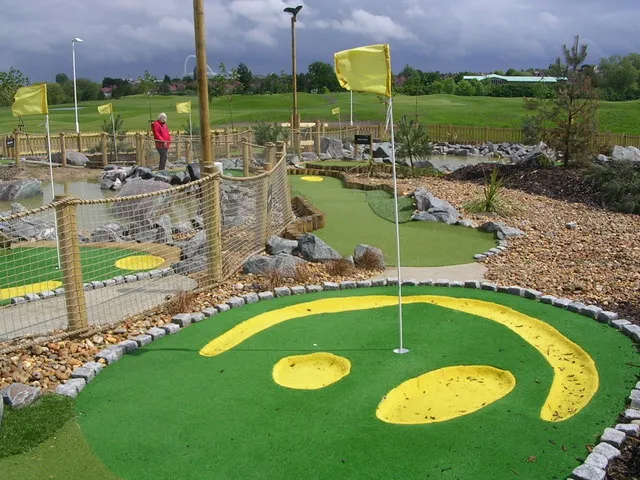
Photo: Mark Percy, CC BY-SA 2.0, via Wikimedia Commons
There is a particular sound that follows a certain kind of British night out. It is the clatter of a plastic ball against a concrete windmill at 1.40am, followed by a cheer that is two-thirds irony and one-third genuine delight. For decades, crazy golf was a seaside afterthought — something to do while eating an ice cream, or to avoid while eating an ice cream. In late 2026, it has become something stranger and more useful: the after-hours cool-down for people who want the buzz of a night out without the bin-bag feeling of an actual afters.
The 1AM Tee Time
Walk into one of the new breed of floodlit courses — a converted warehouse in East London, a repurposed retail unit in Leeds, a seafront site in Brighton that has finally realised its windmill looks better in ultraviolet — and the first thing you notice is the demographic. This is not a lads’ night in matching shirts. It is a mixed, multi-generational crowd: two friends who met at a gig and aren’t ready to go home; a couple who have escaped a sticky bar; a group of NHS workers finishing a late shift and wanting to do something that doesn’t involve shouting over a bassline.
The second thing you notice is the pace. Crazy golf is not a passive activity. You stand, you aim, you miss, you laugh, you move on. It gives a night out a spine. You are not simply occupying a room until the trains start; you are doing something with your hands while having a conversation. In a country where so much of the late-night economy is built around standing near loud music while holding a drink, that is quietly radical.
Why UV Works When Alcohol Doesn’t
The design language of these courses is unmistakable. Blacklight strips turn white shirts into glowing canvases. The balls are luminous — lime, magenta, a radioactive orange that looks like it has escaped from a 1990s rave flyer. The windmills are painted in fluorescent patterns that spin into a blur when someone takes a wild swing. And by the final hole, there is often a small DJ setup: a single speaker, a couple of lights, someone playing disco, garage, or — depending on the venue — a very earnest set of ambient dub.
But the real innovation is not the lighting. It is the licence. Floodlit crazy golf works because it offers the social texture of a night out without demanding that everyone drinks. You can hold a putter and a can of alcohol-free beer. You can be terrible at the game and still have a role. You can be sober, pregnant, driving, skint, or simply done with hangovers, and nobody looks at you as though you have broken a social contract. That is not a small thing. For a lot of people, the traditional British night out is a series of small negotiations with alcohol. Here, the negotiation is simpler: whose turn is it, and why has someone put their ball in the water feature again?
The Economics of a Midnight Putt
For operators, the appeal is obvious. Crazy golf is cheap to run relative to a club. You need a venue, a set of holes, some lights, and a person behind a till. You do not need a full bar, a security team trained for chaos, or a sound system that costs more than a terraced house in Stoke. The overheads are low; the dwell time is high. A group of six will pay for an hour of golf, buy a round of soft drinks, and leave without anyone having to peel them off the floor.
The model is also flexible. Courses can open at 9am for families and stay open until 2am for the after-dark crowd. They can host birthdays, work dos, and first dates. They can lean into the UV aesthetic or keep things gentle and warm. In a high street that is still figuring out what to do with the spaces left behind by retail, a floodlit windmill is not the worst answer.
A Different Kind of Afters
There is a temptation to frame this as a rejection of clubbing. It isn’t. The best of these courses sit alongside the club, not against it. They are the place you go when the club has done its job and you want to talk about it. They are the place you go when you didn’t fancy the club in the first place but still wanted to leave the house. They are the place you go when the last train is an hour away and the alternative is a bus shelter.
That liminal hour — after last orders, before the first train — has always been a problem in British cities. The night economy tends to fall off a cliff. But the floodlit crazy golf course fills that gap with something gentle and social and just competitive enough to be interesting. You will not remember your score. You will remember the moment someone hit a glow-in-the-dark ball so hard it bounced off a windmill and landed in another group’s drinks. You will remember the DJ playing a song you had forgotten you loved. You will remember getting on the first train home with all your faculties intact and a small, stupid smile on your face.
The First Train Home
So much of British nightlife is about intensity. The floodlit crazy golf course is not intense. It is a warm bath of a night out. It is a place where the stakes are low, the lights are high, and the only thing you have to be good at is showing up. In 2026, that feels less like a novelty and more like a correction. We have spent decades building night-time spaces that demand a certain kind of person — a certain tolerance, a certain budget, a certain capacity for noise. The new crazy golf courses ask for something simpler: a willingness to miss a putt in public and laugh about it.
That might not change the world. But it might change your Saturday. And between last orders and the first train home, that is more than enough.